







What is incense?
Incense is made from fragrant plant materials like resins, herbs, woods, and oils, that produces fragrant smoke when exposed to a flame or heat source. Most common incense ingredients you'll hear of are Frankincense, Oud, Myrrh and Sandalwood. Frankincense and Myrrh are usually harvested tree sap that hardens into resins that is subsequently scraped off. Oud and Sandalwood are harvested by cutting off parts of the tree before grinding it into a paste. Both types can be burned to create a fragrant smoke.

Side note: we once had a customer from Oman that shared with us personal stories of how Oman harvests the resins of Frankincense trees from the border of Oman and Somalia. While it can come in a variety of colours, he did say the third harvest produces white sap which is highly coveted. He also shared the biggest issue they have with harvesting the resins are from desert snakes that hide in the branches of the Frankincense tree.
Incense history and cultural significance
Incense has been seen as a sacred religious practise throughout history. It holds cultural significance and therapeutic aroma that can be found all over the world. Ancient civilisations have used it to bridge the gap between man and divinity. From churches with Frankincense and Myrrh, to temples with Sandalwood and Agarwood and Bakhoor in mosques, incense can be found in nearly every religion. As Cathay Newman once wrote, incense "is an unfurling plume of hope directed at the gods".
A practise that has existed since 4000 BC, some of the earliest records of incense used can be traced back to India and Mesopotamia (modern day Iraq, roughly). This ancient practise has been used as offerings and purification. If you've ever wondered how vast the distance incense managed to travel throughout the world; the answer boils down to the Incense Route.

This ancient network connected India to the Arabian Peninsula and later on, to the Mediterranean. This opened up trade of incense, spices and other luxury goods from the east to Mediterranean ports. The route can be traced from across the Levant and Egypt through Northeast Africa and Arabia, through both the sea and the land along the Red Sea, to India and beyond. These channels became key in the trade of Arabian Frankincense and Myrrh to Indian spices such as Black Pepper and Cinnamon, Somalian Frankincense and even gold.
Original natural perfume
While we may commonly think of religious practices when we think of incense (the story of baby Jesus and three wise men may come to mind), there were practical reasons for it too. Like most luxuries in life, incense slowly became a hot commodity amongst noblemen and the rich, going through a commercialisation where it was used for a variety of reasons; masking unpleasant odors to meditation and medical remedies.
Believe it or not, incense was always the original perfume. Yes, long before what we know as perfume came in crystal bottles and crowned with French names, incense was how we scented the air, clothes, hair and body. Even the word perfume comes from Latin "Per Fumum", which means "through smoke".
This can be seen most commonly in the Middle East and Asia, where "perfuming" ones clothes with incense such as Bakhoor or Agarwood were markers of luxury and cleanliness. A common practise you'll find from the Middle East to Japan would be to stand over a smoking burner after dressing. This allows the fragrant smoke to seep into the fabrics and hair, trapping the scent to last.
Misconceptions about Incense
It might seem like an old world practise to use incense unless it's for religious purposes, some might even consider it wasteful or an unnecessary luxury. Incense however, is a great way to offer a soothing fragrance within a space. The long lasting aroma is also a wonderful to create ambience that is cost effective. As it is also plant based, made from natural ingredients, it is also safe for children to enjoy the experience.
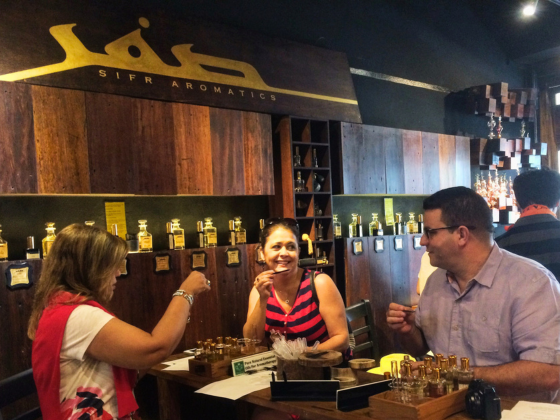
You can find incense almost anywhere in Singapore, technology and widespread use has brought about a wide variety of types and grades that can be used in homes. If you're new to incense and would like to see how it's used and more on the local stories, Sifr Aromatics has an incense demonstration available under the SG Culture Pass. You'll experience the most commonly seen and used incense first hand as our staff gives you a crash course on what to expect and how to use it.
